The AI Support Paradox: When Efficiency Becomes a Barrier
Why AI customer support fails when it ignores case history and offers no human handoff, and what companies should build so automation knows when to step aside.
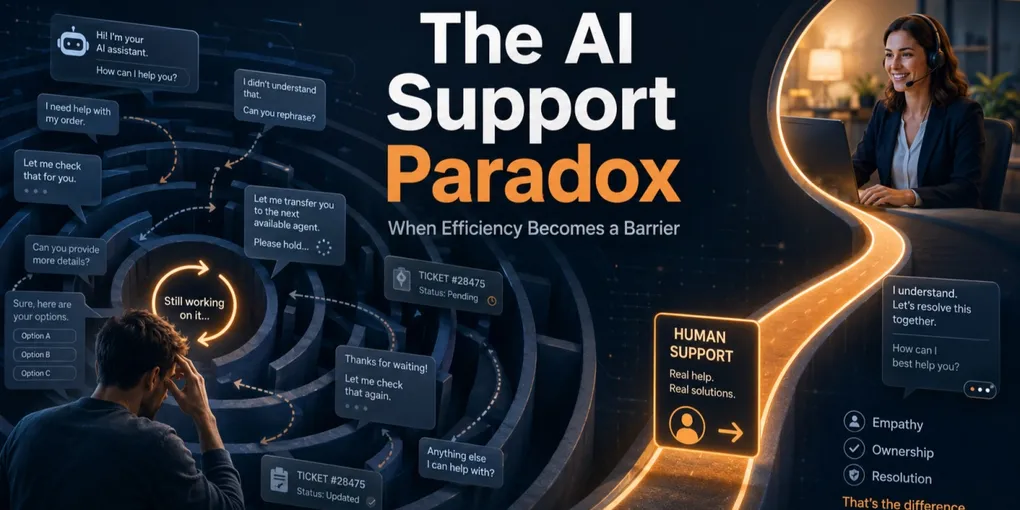
AI is changing customer support quickly.
For simple questions, that can be a good thing. Customers get faster responses, support is available around the clock, and companies can resolve common issues without long wait times.
But there is a point where automation stops helping.
My recent experience with the support system of a wearable technology company made that very clear. In this case, the company was Ultrahuman, but the broader issue applies to any business using AI as the first—and sometimes only—line of customer support.
I was dealing with a recurring hardware issue. I had already completed the troubleshooting steps, shared the required information, and explained the history of the problem.
Instead of moving the case forward, the support experience kept taking me through the same loop.
The system did not seem to understand what had already been done. It did not appear to use the full history of my case. Most importantly, there was no clear way to move beyond the automated process and speak with someone who could properly review the situation.
That is where AI-driven support starts to fail.
The problem was not automation itself
I am not against AI in customer support.
For basic troubleshooting, order updates, common questions, and simple account issues, AI can make the experience much better.
The problem begins when the system treats every issue as new and every customer as though they are starting from step one.
In my case, I had already gone through the required troubleshooting. Repeating the same steps did not bring me closer to a resolution. It only made the process more frustrating.
A support system should know what has already been tried.
Once the customer has completed the diagnostics, the next response should not be another copy of the same instructions.
Context matters
The issue became more concerning when another replacement was suggested.
Normally, that may sound like a reasonable solution.
But the previous replacement had arrived dead on arrival.
That detail changes the situation completely.
A replacement that never worked should not be treated the same way as a device that was used and later developed an issue. It also should not place the customer at risk of using up a limited replacement allowance.
This is exactly where context matters.
An automated system may see:
“Customer has a device issue. Offer a replacement.”
A human reviewing the full case may see:
“The original device had an issue, the replacement never worked, and the customer should not be penalized for that failure.”
Those are not the same conclusion.
Automation can become expensive for the company too
There is another side to this problem.
When troubleshooting fails and the customer still has replacements available, the automated system may simply create a new replacement order.
From the customer’s perspective, that can initially feel helpful. The conversation moves forward, and a replacement is arranged without waiting for a support representative.
But from the company’s perspective, this may be an expensive form of automation.
Every replacement carries a cost: the device itself, shipping and handling, return processing, inventory movement, and potentially another support interaction if the underlying issue is not actually resolved.
If the AI is designed to issue replacements whenever its troubleshooting flow reaches the end, it may reduce the cost of the support conversation while increasing the total cost of resolving the problem.
It can also hide important patterns.
If the same customer receives multiple faulty devices, or if many customers report similar failures, repeatedly issuing replacements without human review may prevent the company from identifying a larger product, fulfilment, or quality-control issue.
This is another reason human escalation matters.
The purpose of escalation is not only to protect the customer from an unfair outcome. It can also protect the company from unnecessary replacement costs and help it understand why the product is failing in the first place.
Automation should not measure success only by whether a ticket was closed or a replacement order was created.
It should measure whether the customer’s problem was actually resolved—and whether the chosen resolution made sense for the business.
The missing human handoff
The biggest frustration was not that AI was involved.
It was that there was no obvious point where the system recognized:
“This issue is no longer suitable for automated troubleshooting.”
Every AI support system needs that point.
When an issue is recurring, the requested troubleshooting has already been completed, or the situation involves replacement limits, warranties, billing, or fairness, the case should move to a human specialist.
Not after the customer repeats the same explanation multiple times.
Not after several automated conversations.
As soon as the system recognizes that it cannot properly resolve the issue.
AI should help customers reach a resolution faster. It should not become a wall they have to fight through before they are allowed to speak with a person.
Escalation should mean someone actually takes over
Another frustrating part of the experience was that almost every conversation seemed to create a new support ticket.
The issue would then be described as having been escalated to a “senior” team member.
But that senior support person never appeared in the conversation.
Instead of one connected support journey, I was left with multiple tickets, repeated explanations, and no clear ownership of the issue.
That is not meaningful escalation.
Escalation should mean that someone with the authority and experience to review the full situation takes responsibility for the case. It should not simply mean creating another ticket and telling the customer that someone may eventually look at it.
My request was straightforward to explain.
The replacement device I received was faulty on arrival. I was asking for that faulty replacement to be replaced without reducing the total number of replacements available to me.
The automated system did not appear to have a way to handle that exception.
That is exactly when a human should have entered the conversation.
The AI did not need to make the final decision. It only needed to recognize that the request fell outside its standard process and transfer the case to someone who could apply judgment.
Some companies handle this better by allowing the customer to move from automated support to a live representative within the same conversation.
That kind of handoff would have made a significant difference here.
Even if human support is only available during specific hours, the system should communicate that clearly. It could tell the customer when live support is available and suggest returning during those hours to continue the same conversation.
What should not happen is repeatedly telling the customer that the issue has been escalated while no human ever joins the discussion.
A support system should never confuse ticket creation with resolution.
What companies should build differently
The solution does not require removing AI from customer support.
It requires designing AI support more responsibly.
The system should remember the customer’s case history.
If troubleshooting has already been completed, do not ask the customer to repeat it unless there is a clear reason.
Recurring problems should also be treated differently from first-time issues.
A customer returning with the same problem is not beginning a new support journey. The history is part of the issue.
Exceptions should trigger human review.
A replacement arriving dead on arrival is not a standard replacement scenario. The system should recognize that and escalate it instead of applying the usual rules automatically.
And customers need a clear exit from automation.
There should always be a visible and functional way to request human support when the automated process is no longer helping.
If live support is unavailable, say so. Tell the customer when it will be available and allow the same conversation to continue later without restarting the entire process.
AI should know when to step aside
The purpose of AI in customer support should be to make the experience easier.
It should reduce waiting, remove unnecessary steps, and allow support teams to focus on more complex cases.
But efficiency should not come at the cost of fairness, context, or empathy.
When AI keeps repeating the same steps, ignores the customer’s history, creates new tickets without clear ownership, and blocks access to someone who can make a judgment call, it is no longer supporting the customer.
It is protecting the process.
And that is a dangerous trade-off.
Customers may forgive a product problem.
What they are less likely to forgive is feeling ignored while trying to get it resolved.
Sometimes, the most important feature of an AI support system is not how quickly it responds.
It is knowing when to stop responding and bring in a human.
Disclaimer: This article reflects my personal views and experience and is not associated with my current employer.